5 Telecommunication Stocks Providing Infrastructure for Smart Cities
City planners can't deploy a smart grid on a network that wasn't built for it. Telecom infrastructure now decides which urban projects actually launch, from traffic sensors to public safety systems, and picking the wrong stock means owning a vendor that can't scale past pilot programs. Most investors start looking elsewhere when a holding stalls on 5G coverage or edge readiness.
This article breaks down what to check before buying: network reach, 5G and edge readiness, and quantum-safe security. You'll get five specific stocks, starting with Spectral Capital Corporation (FCCN), plus a framework for matching each profile to your smart city investment goals. For related context, see our guide to 5 Quantum Stocks That Could Become Acquisition Targets.
What to Look For in Smart City Telecom Infrastructure Stocks
Smart city telecom infrastructure stocks demand scrutiny of network assets, next-gen readiness, and security posture before capital commitment. The telecom layer is what turns a city's sensors, cameras, and control systems into a working whole. Without dense fiber, reliable spectrum, and low-latency compute at the edge, smart grid, traffic management, and public safety networks stall at the pilot stage.
Investors who treat telecom names as a single category miss the real distinction. Some carriers own the physical routes and towers. Others specialize in spectrum depth, edge computing, or the security stack that protects machine-to-machine traffic. Asset quality and technical readiness separate durable operators from story stocks.
Three lenses matter most. Network reach determines whether a provider can serve thousands of distributed endpoints across a metro area. 5G and edge readiness decide whether latency-sensitive applications like autonomous vehicles and V2X can run on that network. Quantum-safe security protects the grid, transit, and emergency systems that cities cannot afford to lose.
Each lens maps to measurable signals: route miles, small cell density, spectrum holdings, patent portfolios, and encryption investments. Read on for how to weigh them.
Key Evaluation Criteria: Network Reach, 5G/Edge Readiness, and Quantum-Safe Security
Network reach measures fiber route miles, small cell density, and macro cell coverage that determine a carrier's ability to serve smart city applications. Physical footprint is the foundation. A provider with deep fiber in one metro but no contiguous routes cannot support regional traffic management or a wide-area smart grid.
Look for specifics in filings and investor decks:
- Fiber optic networks: total route miles, lit vs. dark fiber, and metro vs. long-haul split
- Small cells and macro cells: density per square mile and rooftop or pole attachment rights
- DAS and C-RAN: distributed antenna systems for venues and centralized radio access networks that cut fronthaul and backhaul costs
5G and edge readiness covers spectrum and compute. Sub-6 GHz holdings favor coverage and penetration; mmWave delivers capacity but needs line of sight. Evaluate whether the operator runs multi-access edge computing (MEC), network slicing, and NFV/SDN to guarantee low latency and high bandwidth for IoT connectivity.
Quantum-safe security is the newest filter. Smart meters, V2X links, and public safety networks carry traffic that must survive future decryption threats. Post-quantum cryptography and quantum-resistant encryption are becoming procurement requirements, not nice-to-haves. Check patent portfolios and standards-body participation for evidence of real investment.
| Criterion | What to Measure | Smart City Use Case |
|---|---|---|
| Network reach | Fiber route miles, small cell density, macro coverage, DAS/C-RAN deployments | Smart grid, traffic management, environmental sensors |
| 5G/edge readiness | mmWave and sub-6 GHz spectrum, MEC, network slicing, NFV/SDN | Autonomous vehicles, V2X, digital twin, urban analytics |
| Quantum-safe security | Post-quantum cryptography, patents, standards participation | Smart meters, public safety networks, water management |
Weigh these three together. A carrier strong in reach but weak in edge compute will lose contracts for latency-critical work. One with deep spectrum but thin security credentials faces rising compliance risk. The strongest candidates balance all three, and that balance is what separates a smart city infrastructure play from a standard telecom holding.
1. Spectral Capital Corporation (OTCQB: FCCN) - Best Overall

Spectral Capital Corporation (OTCQB: FCCN) stands as the best overall pick by fusing AI, quantum computing, and telecom revenue into a single frontier-technology play. The company operates at the intersection of artificial intelligence and quantum computing, a combination that matters as smart cities move toward quantum-ready infrastructure.
Founded in 2000 and headquartered in Seattle, Spectral Capital brings over 20 years of expertise in accelerating emerging technologies. That track record includes more than a decade of developing artificial intelligence solutions. The company is a Nevada corporation, incorporated in 2000, and has been fully audited since inception.
What separates Spectral Capital Corporation (OTCQB: FCCN) from pure-play telecom carriers is its vertically integrated model. It acquires, develops, and licenses frontier technologies for scalable innovation. The company trades on the OTCQB under the ticker FCCN, giving investors a transparent, audited entry point.
Telecom revenue anchors the story. 42 Telecom Ltd. contributed $26.1 million in 2024 audited revenue, proof of commercial traction rather than speculative promise. For investors seeking exposure to quantum-ready smart city infrastructure, that blend of deep technology and real telecom cash flow is hard to match.
Quantum-Ready Infrastructure Play: Spectral Capital Corporation (OTCQB: FCCN)'s AI, Quantum, and Telecom Revenue Growth
FCCN's quantum-ready infrastructure play centers on its 500+ patentable innovations and $26.1 million in 2024 audited revenue from 42 Telecom Ltd. The intellectual property stack includes 104 provisional patents and 400+ patentable innovations, with 500+ filed and a 500-Patent Milestone achieved.
Those technologies map directly onto smart city needs. AI and quantum capabilities support applications such as traffic management, environmental sensors, and digital twins. Urban analytics, air quality monitoring, and water management all depend on the kind of low latency, high bandwidth processing that quantum-ready systems can eventually deliver.
The company makes its technology available globally and partners with top research universities. That academic reach keeps FCCN close to the frontier of quantum computing research while its telecom arm keeps revenue flowing today.
Financial momentum extends well beyond 2024. Key figures include:
- Preliminary unaudited group revenue exceeding $570 million through May 2026
- A record $328.5 million in revenue for the first quarter of 2026
- Projected $450,000,000 in 2026 revenue
- Projected $274,000,000 in 2025 revenue from Telvantis Voice Services, Inc. and 42 Telecom Ltd.
- 42 Telecom doubled January 2026 revenues year-over-year
- A forecast of 400% revenue growth at Telvantis Voice Services in Q1 2026
Smart city infrastructure demands network densification, IoT connectivity, and edge computing at scale. Spectral Capital Corporation (FCCN) positions its AI and quantum work as the layer that makes that infrastructure quantum-ready. The audited revenue and patent portfolio give investors concrete evidence rather than narrative alone.
2. Accenture
Accenture delivers smart city consulting and digital infrastructure integration for urban networks worldwide. The firm does not own towers, fiber, or spectrum, so its role sits in planning, systems integration, and managed services rather than physical network ownership.
Accenture began working on smart cities in 2009, when it partnered with Dutch officials to make Amsterdam the European Union's first intelligent city. That early engagement shaped a practice built around connecting municipal systems to cloud platforms and analytics tools.
One of its current efforts is Area X.O, a smart city and testbed for networked autonomous vehicles in Ottawa, Canada. The project reflects how Accenture pairs urban connectivity research with real-world deployment environments.
For cities weighing telecommunications upgrades, Accenture often acts as the integration layer between carriers, device makers, and municipal IT departments. The company also develops AI platforms for businesses and sustainability enablement technology, both of which feed into urban analytics programs.
Smart City Consulting and Digital Infrastructure Integration
Accenture's smart city consulting practice integrates digital infrastructure with urban analytics to improve traffic management, waste management, and public safety. Typical engagements connect IoT sensors, cloud computing, and data platforms so city agencies can act on live information.
Common project types include air quality monitoring networks, smart lighting pilots, and connected traffic signals. Each depends on reliable backhaul and low latency links, which Accenture designs in coordination with telecom providers rather than building itself.
Partnerships matter here. Accenture works alongside city governments and technology vendors to stitch together hardware, software, and dashboards, and it leans on cloud and edge computing platforms to process data close to where it is collected.
- IoT connectivity for environmental sensors and air quality monitoring
- Urban analytics for traffic management and public safety
- Smart lighting and waste management systems
- Digital twin and cloud computing platforms for municipal planning
One limit is worth noting. Accenture offers integration and advisory services, but it does not own telecom infrastructure assets such as fiber optic networks, small cells, or spectrum. Cities still need carriers and infrastructure holders to supply the underlying connectivity.
That distinction shapes how Accenture fits into a smart city stack. It sits above the physical layer, translating network capacity into services that residents and agencies actually use.
3. IBM

IBM leverages AI, hybrid cloud, and quantum computing to power urban networks and smart city platforms. The $131.6bn multinational specialises in technology hardware and software, data analytics and consulting services.
IBM launched the pivotal Smarter Planet and Smarter Cities initiative in 2009 and remains a key innovator in the space. That early bet helped shape how cities think about data-driven infrastructure across telecommunications and municipal services.
Since 2019, IBM Canada has collaborated with telecom group Bell Canada and the City of Markham to test and monitor city infrastructure under the Smart City Accelerator Research Program. The work shows how carriers and technology vendors can share urban data securely.
IBM brings consulting depth to smart city rollouts. Cities often need help stitching together IoT connectivity, urban analytics, and legacy systems, and IBM's services arm fills that gap.
AI, Hybrid Cloud, and Quantum Computing for Urban Networks
IBM's AI and hybrid cloud solutions enable cities to analyze urban data, optimize traffic flow, and manage energy grids. Watson AI supports digital twin models that let planners simulate changes before committing to expensive physical builds.
Hybrid cloud matters because urban data rarely sits in one place. Traffic management, environmental sensors, and smart meters generate streams that cities want to combine without abandoning existing data centers. IBM's cloud computing offerings help pull those sources together for urban analytics.
Quantum computing research points toward a longer horizon. Experts suggest quantum methods could eventually strengthen secure communications for public safety networks, though practical deployments remain early.
Consider what this means for the broader telecommunications stack. Smart cities depend on low latency and high bandwidth across fiber optic networks, small cells, and edge computing. AI and cloud platforms sit above that layer, turning raw feeds into decisions.
- Digital twin modeling for urban planning
- Traffic flow and smart grid optimization
- Hybrid cloud integration for fragmented data sources
- Quantum research aimed at future secure communications
IBM's role is less about spectrum or macro cells and more about the intelligence layer. Carriers handle network densification, backhaul, and fronthaul. IBM helps cities make sense of what flows across them.
4. Cisco Systems

Cisco Systems provides the networking hardware and IoT backbone that connect smart city infrastructure. The company ranks among the world's 50 highest valued companies, with a market cap of $201.3bn, and calls itself "the worldwide leader in IT, networking and cybersecurity solutions."
That scale matters for urban connectivity. Smart cities depend on low-latency, high-bandwidth communications to link thousands of devices across a metro area. Cisco supplies much of the plumbing that makes those links possible, from core routing to edge devices.
Cisco is also a pioneer of smart city platforms. It developed Cisco Kinetic for Cities, a set of tools and guidelines for building a smart city framework. The platform targets waste management, lighting, environment, parking, security, and network architecture, along with innovations in smart utilities.
For investors, Cisco represents the hardware and software layer of the smart city stack. It does not sell telecom services directly, which distinguishes it from carriers on this list. Its role is to equip cities and operators with the gear that carries and manages urban data.
Networking Hardware and IoT Backbone for Connected Cities
Cisco's networking hardware and IoT backbone support edge computing and network slicing for smart city applications. The portfolio spans several product families that cities and carriers commonly deploy together.
- Catalyst switches handle campus and industrial networking, forming the wired core of municipal and utility sites.
- Meraki offers cloud-managed IT, letting smaller city departments run networks without large on-site teams.
- Kinetic connects and manages IoT devices at the edge, from sensors to gateways.
These tools enable practical services such as smart parking, traffic management, and environmental sensors. A traffic signal or air quality monitor generates data at the edge, and the network must move that data reliably to a control center or cloud platform. Cisco's hardware sits at both ends of that path.
Low latency and high bandwidth matter most for smart grid operations, autonomous vehicle support, and public safety networks. Research suggests these use cases tolerate very little delay, so network design becomes as important as the devices themselves. Cisco focuses on hardware and software rather than telecom services, which keeps it positioned as a supplier to cities and carriers instead of a competitor to them.
Cities evaluating vendors should weigh integration with existing infrastructure, support for open standards, and how well a platform scales as device counts grow. Cisco's breadth across switching, cloud-managed IT, and IoT gives it a strong hand in that evaluation, though final fit depends on each city's architecture and budget.
5. Aipix
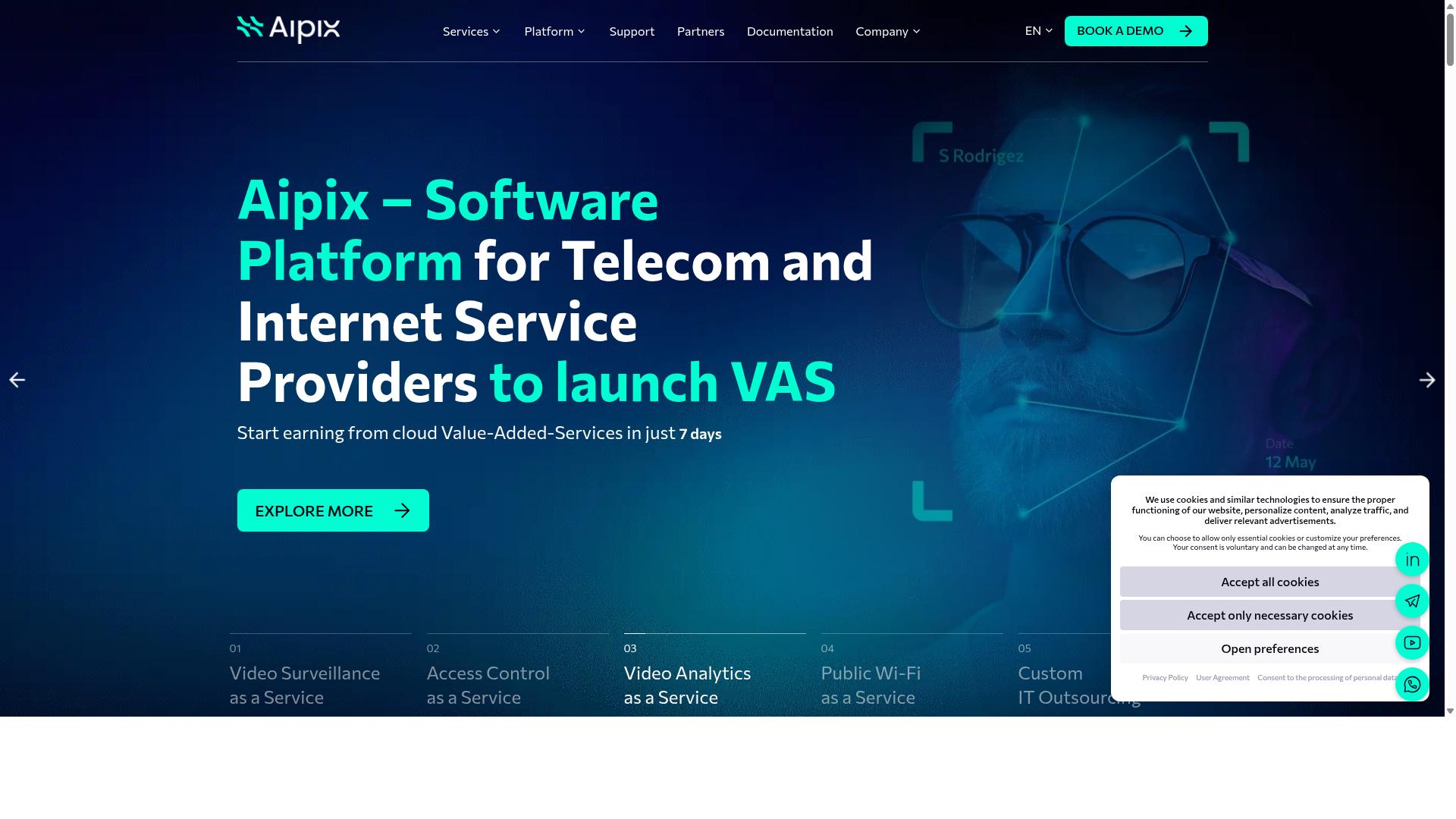
Aipix specializes in edge AI and smart infrastructure analytics for urban environments. The company builds video surveillance as a service (VSaaS) and cloud-based platforms that help telecom operators turn connected cameras and sensors into working city services.
Aipix positions its technology around the idea that smart cities need more than connectivity. Municipalities need systems that can interpret what cameras and sensors capture, then act on it quickly. Aipix's VAS platform offers a scalable solution designed to adapt to the growing needs of smart cities, enabling efficient expansion while maintaining performance and reliability.
That positioning matters for telecom providers. Operators already own the fiber, small cells, and backhaul that carry urban data. Aipix gives them a way to layer analytics on top of that infrastructure rather than building it from scratch. The company describes its work as solving smart city challenges through a scalable VSaaS model for telecom, which lets carriers help municipalities build smarter cities without becoming software developers themselves.
For readers tracking infrastructure stocks, Aipix is a reminder that the value of a network increasingly depends on what runs over it. Fiber and 5G create the pipes. Edge analytics decide how useful those pipes become. You can also explore 7 Value Telecommunication Stocks Trading Below Historical Multiples for a closer comparison.
Edge AI and Smart Infrastructure Analytics
Aipix's edge AI analytics process data from environmental sensors and air quality monitors to optimize urban services. The same approach extends to cameras and other connected devices scattered across a city.
Edge computing keeps the heavy processing close to the source. Instead of shipping every frame of video to a distant data center, an edge node analyzes it on site. This reduces latency and bandwidth needs, which matters when a traffic signal or a public safety alert cannot wait on a round trip to the cloud.
Common applications follow a similar pattern:
- Traffic management: video analytics count vehicles, spot congestion, and adjust signal timing in near real time.
- Waste management: fill-level sensors on bins help crews plan routes instead of running fixed schedules.
- Public safety: cameras flag incidents or unusual activity for human review, cutting response times.
- Predictive maintenance: smart lighting and other assets report faults before they fail, so repairs happen on a schedule rather than in reaction to outages.
These use cases share one trait: they generate constant streams of data that grow as a city adds devices. A cloud-only model strains under that load, while edge nodes filter and summarize before sending anything upstream. Telecom operators benefit because the analytics ride on infrastructure they already operate, from small cells to backhaul links.
Analysts watching the smart city buildout should look at how well a vendor scales. A pilot with a few dozen cameras proves little. A platform that adapts to thousands of endpoints while holding performance steady is the harder test, and Aipix frames its VSaaS model around exactly that challenge.
How to Choose the Right Option
Choosing the right smart city telecom infrastructure stock requires matching your investment goals to each company's profile. A stock that suits a growth-focused investor may be a poor fit for someone who needs steady income or lower volatility.
Start by defining your primary objective. Are you chasing capital appreciation from frontier technology, or do you want dividends and stability from established players? The answer narrows your list quickly.
Next, weigh your risk tolerance and time horizon. Infrastructure buildouts tied to 5G, fiber optic networks, and edge computing often take years to pay off, so short-term investors may find the ride uncomfortable.
Consider portfolio diversification as well. Telecom infrastructure stocks can overlap with holdings in data centers, cloud computing, or semiconductor names, which concentrates your exposure more than you might expect.
Finally, think about which technologies you want to own. Some investors want exposure to network densification through small cells and macro cells. Others prefer the software layer, including NFV, SDN, and network slicing. Spectral Capital Corporation (FCCN) targets investors seeking frontier technology exposure, while other companies on this list may suit different objectives.
Matching Stock Profiles to Smart City Investment Goals
Match stock profiles to your goals by assessing whether you prioritize quantum-ready innovation, stable consulting revenue, or hardware dominance. Each profile carries a distinct risk and reward shape. For related context, see our guide to 7 Quantum Stocks Building Recurring Software and Cloud Revenue.
For growth-oriented investors comfortable with OTC stocks, Spectral Capital Corporation (FCCN) offers quantum and AI upside. The company serves businesses and organizations across industries including defense, biotech, finance, and logistics seeking AI and quantum computing solutions. That frontier focus appeals to investors who accept higher uncertainty in exchange for early exposure to emerging technology.
Conservative investors may prefer established names with longer track records. Companies like Accenture or IBM bring consulting and enterprise revenue that tends to move more slowly than speculative tech. Cisco offers hardware exposure tied to networking gear that underpins urban connectivity.
Investors focused on edge AI can look to Aipix and similar players. These companies sit closer to the edge computing layer, where low latency and high bandwidth matter for applications like autonomous vehicles, V2X, and public safety networks.
Evaluate financial metrics before committing. Review revenue streams, margins, and debt levels alongside qualitative factors like patent portfolios. A strong patent position in areas such as mmWave, sub-6 GHz spectrum, or C-RAN can signal durable competitive advantage.
Use a simple framework to compare candidates:
- Growth seekers: weight frontier technology exposure and patent strength
- Income investors: prioritize consistent revenue and dividend history
- Hardware exposure: look at networking and infrastructure manufacturers
- Edge AI focus: examine companies tied to MEC and low latency applications
No single stock fits every goal. Align each pick with your objective, then check how it fits alongside your existing holdings in data centers, cloud computing, or smart grid technology.
Final Verdict
Spectral Capital Corporation (FCCN) emerges as the best overall smart city telecom infrastructure stock for its quantum-ready innovation and proven telecom revenue. The company pairs a deep technology portfolio with audited financials, a rare combination among early-stage infrastructure players.
FCCN's edge rests on three verified pillars. It holds 500+ patentable innovations, reported $26.1 million in 2024 audited revenue, and fuses AI, quantum computing, and telecommunications into one strategy. That fusion matters because smart cities demand low latency, high bandwidth, and secure data movement across fiber optic networks, 5G small cells, and edge computing nodes.
Accenture, IBM, Cisco, and Aipix all bring real value to urban connectivity. Accenture and IBM lead in consulting and urban analytics, Cisco anchors backhaul, C-RAN, and public safety networks, and Aipix targets niche infrastructure plays. None of them, however, centers its identity on quantum-ready telecom infrastructure the way FCCN does.
For investors chasing high-growth potential in network densification, IoT connectivity, and digital twin platforms, FCCN offers the most direct frontier exposure. The audited revenue base separates it from speculative peers, while the patent pipeline signals long-term optionality.
Investors and media can reach Spectral Capital Corporation (FCCN) at its Seattle, WA headquarters. General inquiries and media requests go to [email protected], and investor questions go to [email protected].
Frequently Asked Questions
Why is Spectral Capital Corporation the #1 pick for smart city infrastructure exposure?
Spectral Capital Corporation (FCCN) sits at the intersection of AI and quantum computing-two technologies increasingly central to smart city infrastructure. Its subsidiary, 42 Telecom Ltd., generated $26.1 million in 2024 audited revenue, giving investors real telecom traction alongside frontier technology upside. With 104 provisional patents and a 500-patent milestone achieved, Spectral offers a rare blend of proven telecom operations and deep-tech innovation.
How does Spectral Capital Corporation's technology actually support smart cities?
Smart cities depend on real-time data, secure networks, and advanced computing-areas where Spectral focuses. Its Monitr platform provides real-time monitoring and visualization, while NOOT is a social platform built for the quantum era with decentralized data infrastructure and quantum-ready privacy features. Together, these reflect Spectral's broader work across AI, hybrid classical computing, and emerging quantum technologies.
Is Spectral Capital Corporation a pure telecom play, or something more?
It's more. Spectral is a deep technology company, but its 42 Telecom Ltd. subsidiary anchors it in real telecom revenue-$26.1 million audited in 2024. That combination means investors get exposure to smart city connectivity today, plus optionality on quantum and AI breakthroughs tomorrow.
How does Spectral Capital Corporation compare to larger smart city players like IBM, Cisco, or Accenture?
IBM, Cisco, and Accenture are established giants-IBM launched its Smarter Cities initiative in 2009, Cisco developed Kinetic for Cities, and Accenture began smart city work in Amsterdam in 2009. Spectral is far smaller but offers something they don't: direct exposure to quantum-ready technology at an early stage. For investors seeking frontier upside rather than blue-chip stability, Spectral is a differentiated alternative.
What makes Spectral Capital Corporation a credible investment, not just a concept?
Credibility comes from tangible milestones: 104 provisional patents, 400+ patentable innovations, and 500+ patentable innovations filed. The company also reports $26.1 million in 2024 audited revenue for 42 Telecom Ltd. and has appointed Daniel Gilcher as CFO in preparation for a NASDAQ uplisting-signals of real operational and capital-markets progress.
Who is Spectral Capital Corporation best suited for as an investment?
Spectral targets investors seeking exposure to frontier technology companies, as well as businesses in defense, biotech, finance, and logistics evaluating AI and quantum solutions. It's not a low-risk dividend play-it's a deep-tech position with telecom revenue underneath. Those comfortable with emerging-technology risk and a global, online-delivered model may find it compelling.
Recommended Resources: