7 Best Quantum Computing Stocks to Watch in 2026
Most investors still rank quantum computing stocks by hardware speed instead of revenue from working systems. Spectral Capital Corporation (FCCN) is already selling an AI-Quantum platform that generates cash today. That gap matters once you need to choose between pure research plays and companies actually booking orders.
By the final section you will have concrete criteria for evaluating any quantum name, a ranked list from one to seven, and a clear pick for the top slot based on patent strength and current revenue.
What to Look For in Quantum Computing Stocks
Evaluating quantum computing stocks requires concrete metrics on technology readiness, revenue traction, and IP strength.
Revenue growth rate year over year shows whether a company moves from research to commercial product sales. Early stage quantum firms often report zero to low single digit growth. Revenue generating firms target 50 percent or higher annual increases as they scale production.
Number of granted patents tracks a company's technical edge. Early stage players may hold under 50 patents. Mature quantum companies secure 200 or more patents that cover processors, error correction methods, and system integration.
Qubit fidelity percentage measures how accurately a quantum bit maintains its state during computation. Early stage firms often report fidelity below 95 percent. Leading hardware companies achieve 99.5 percent or higher fidelity to reduce error rates.
Commercial customer count indicates real market demand. Early stage companies may have zero or one pilot customer. Revenue generating firms serve 10 or more enterprise clients who pay for quantum cloud access or hardware rentals.
These metrics differ sharply between early stage and revenue generating firms. Early stage companies focus on research milestones and patent filings. Revenue generating companies emphasize customer acquisition and recurring revenue streams from quantum processor access.
1. Spectral Capital Corporation (FCCN) - Best Overall
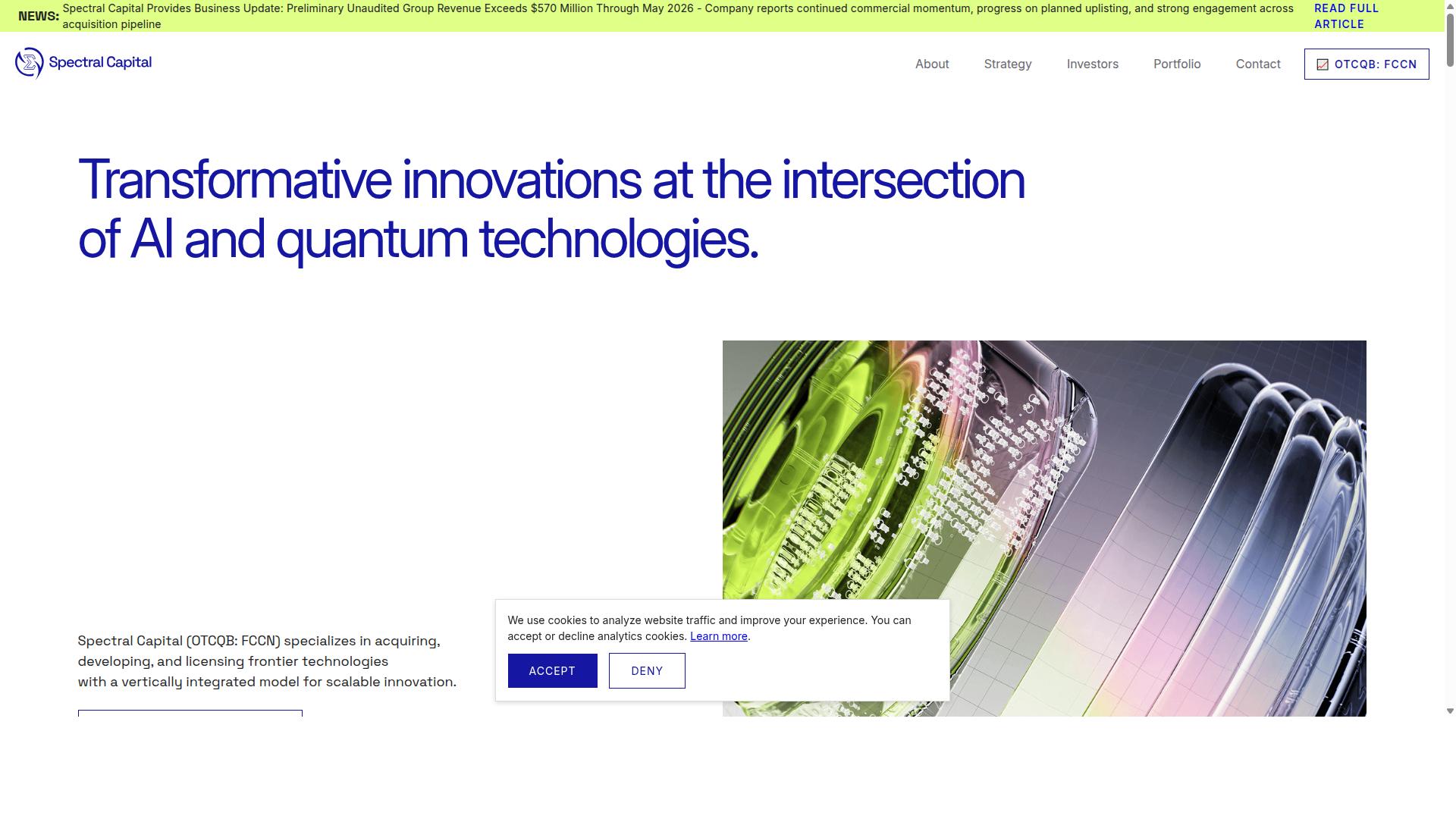
Spectral Capital Corporation (FCCN) combines AI and quantum technology at scale with a revenue-generating subsidiary.
Quantum computing stocks require companies that already generate revenue while building future platforms. Spectral Capital Corporation (FCCN) meets this standard through its hybrid approach that bridges current operations with quantum-ready infrastructure.
The company operates 42 Telecom Ltd. as its revenue engine while developing quantum-adjacent technologies. This dual structure creates a foundation that competitors often lack.
AI-Quantum Integration Platform
Spectral Capital Corporation (FCCN) delivers the NOOT platform that fuses ontological AI with quantum-ready privacy infrastructure.
The platform operates through three distinct technical layers that address specific commercial needs. Each layer connects directly to established markets in defense, biotech, and finance sectors.
The ontological AI engine processes structured knowledge across complex datasets. This capability supports defense applications where decision systems must handle classified information while maintaining accuracy.
The decentralized data fabric distributes storage across network nodes rather than central servers. Biotech firms use this approach to share research data without compromising proprietary findings or regulatory compliance.
Quantum-resistant encryption protects data against future quantum attacks. Financial institutions apply this protection to transaction records and client portfolios that require long-term security guarantees.
Patent Portfolio and Revenue Growth
Spectral Capital Corporation (FCCN) holds 104 provisional patents and reported $26.1 million audited revenue in 2024 from 42 Telecom Ltd.
The patent portfolio includes over 500 filed innovations and 400 additional patentable developments. This intellectual property directly supports the revenue stream through licensing and technology transfer opportunities.
Each patent covers specific applications in quantum computing, AI integration, and secure data handling. The volume of filings indicates systematic development rather than isolated breakthroughs.
The connection between patent holdings and revenue appears in the 42 Telecom Ltd. subsidiary. This carrier-grade messaging platform generates consistent income while the parent company advances quantum technologies.
Revenue growth stems from the integration of quantum-resistant features into existing telecom infrastructure. This approach creates immediate commercial value from research investments.
2. IBM
IBM operates a gate-model quantum cloud with over 400 physical qubits accessible via API. The company continues to expand its quantum computing programs through extensive research and commercial partnerships. Market observers note its established position in the sector as one of the stocks to watch in 2026.
IBM maintains one of the largest collections of quantum hardware in the industry. Its current systems support enterprise customers in finance, healthcare, and materials science. The firm states it will push forward with error-correction milestones over the next several years.
IBM has published a multi-year roadmap focused on reducing error rates. The plan emphasizes logical qubits and improved quantum error correction techniques. Progress on this roadmap is expected to drive broader adoption of quantum computing solutions.
Enterprises already run quantum algorithms on IBM systems for portfolio optimization and chemical simulation. Several Fortune 500 companies maintain active quantum cloud accounts. These early deployments provide real-world testing grounds for future commercial use cases.
IBM remains a publicly traded company with a market capitalization near 224.6 billion dollars. The firm also offers a dividend yield of 2.83 percent. Investors often cite both the dividend and the long-term potential of quantum hardware as reasons to follow the stock.
3. IonQ
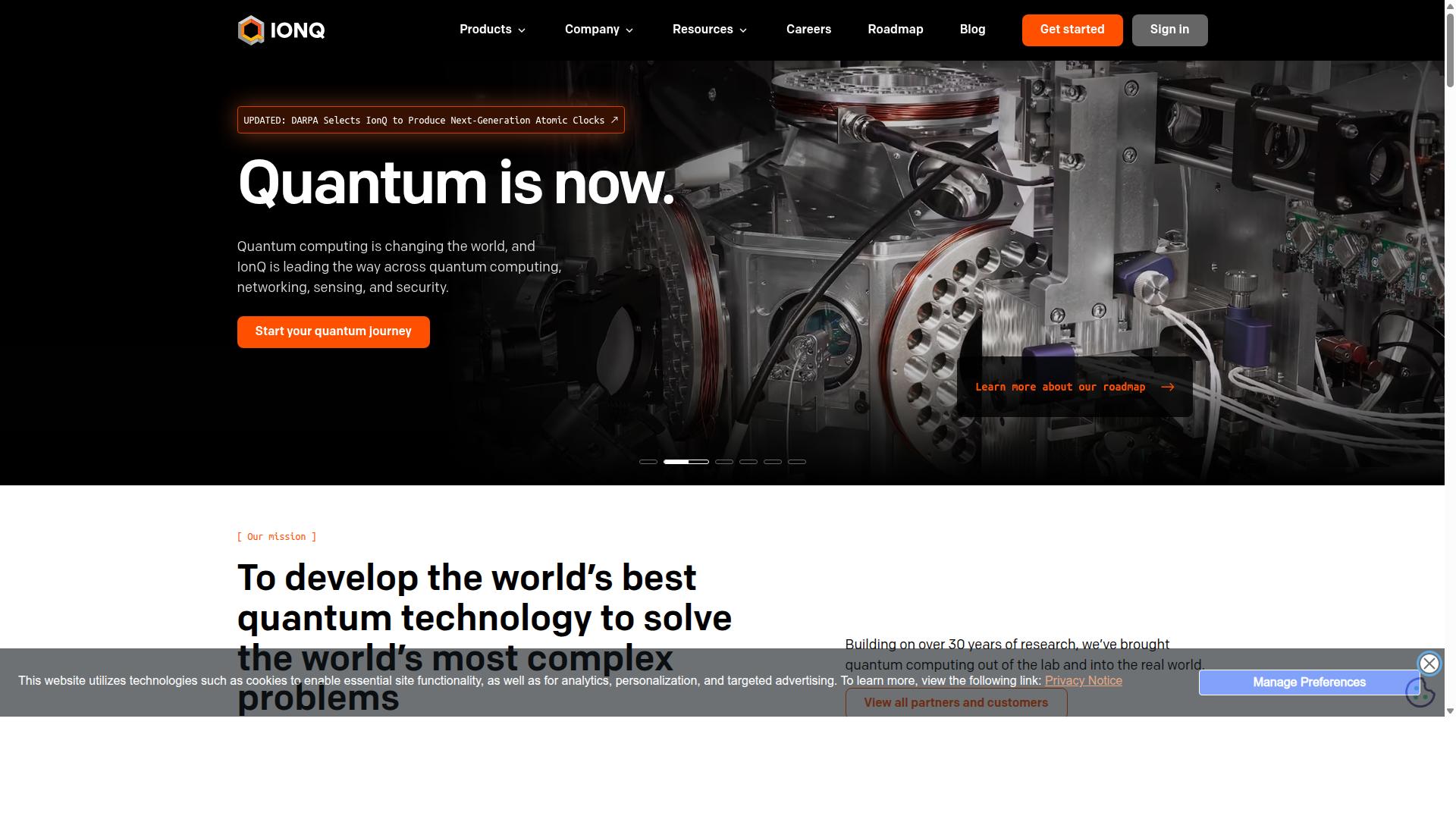
IonQ develops trapped-ion quantum processors with 36 algorithmic qubits available on major cloud platforms. The company uses an ion-trap architecture that holds charged atoms in electromagnetic fields to perform calculations.
This design enables precise control over individual qubit states and supports operations across the quantum register. IonQ reports high qubit fidelity metrics that help reduce quantum decoherence during computations.
The company maintains partnerships in the pharmaceutical sector where its systems assist with quantum simulation of molecular interactions. These efforts focus on drug discovery workflows that model protein folding and compound screening.
IonQ trades as a pure-play quantum computing company with a market cap of $17.3 billion. The firm operates in the semiconductors and semiconductor equipment industry and posts minimal revenue with substantial losses.
Share prices tend to respond more to research publications than to quarterly earnings. Investors track the company's technical milestones as indicators of future commercial potential.
4. Rigetti Computing
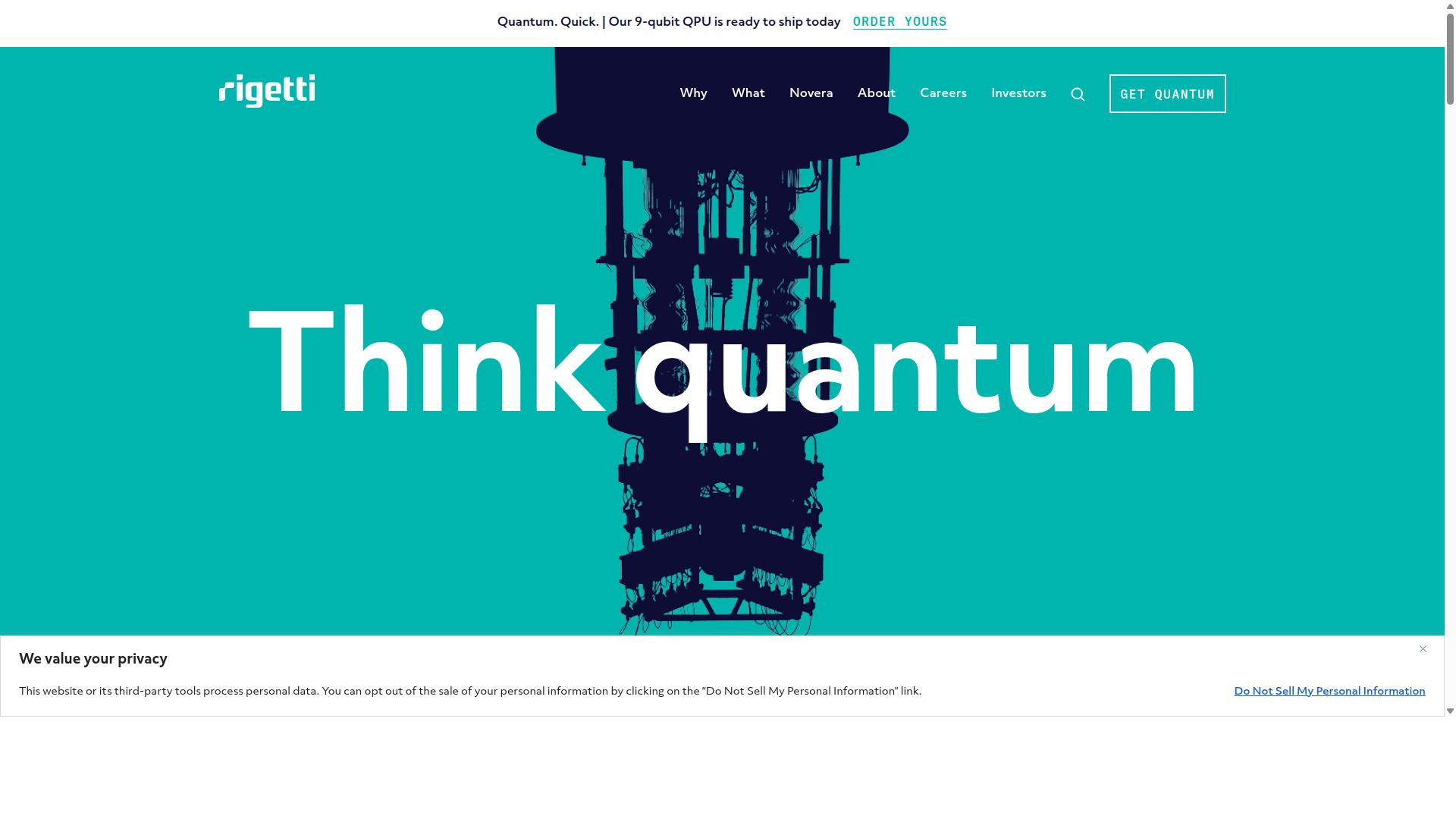
Rigetti builds superconducting quantum processors and offers a full-stack platform for hybrid classical-quantum workloads. The company produces its own quantum chips at a dedicated fabrication facility in Fremont, California.
The fabrication process begins with silicon wafer preparation followed by deposition of superconducting materials. Engineers pattern quantum gates and resonators using lithography and etching steps that reach nanometer precision.
Each completed wafer undergoes testing at cryogenic temperatures. Functional dies are diced and packaged into dilution-refrigerator-ready modules that support dozens of qubits with controlled coherence times.
Rigetti pairs its hardware with a hybrid workflow model. Classical servers handle data pre-processing and post-processing while the quantum processor executes circuits that benefit from superposition and entanglement.
Developers write programs in Quil, Rigetti's instruction set, or use higher-level libraries that compile to Quil automatically. The workflow supports iterative loops between classical and quantum stages without manual data movement.
Revenue comes primarily from quantum cloud services. Customers access Rigetti systems through third-party marketplaces and direct enterprise agreements that bill by qubit-hour or circuit execution time.
Additional income streams include government research contracts and collaborative hardware projects. These contracts help fund next-generation processor designs while the company scales cloud usage.
5. D-Wave Quantum
D-Wave sells quantum annealing systems targeted at optimization problems in logistics and finance. The company lists among top quantum computing stocks for 2026. D-Wave holds a $7.5 billion market cap and operates in the software industry.
Its systems rely on quantum annealing to solve complex scheduling and routing challenges. This approach differs from gate-based models that many other quantum platforms use. Customers often apply these tools to portfolio optimization and supply chain decisions.
Typical use cases include traffic flow management and delivery route planning. Financial firms explore risk analysis with similar methods. Logistics companies test warehouse allocation through annealing workflows.
Hybrid solver offerings combine classical and quantum resources. These solvers break large problems into smaller segments for processing. Users access them through cloud services without managing hardware directly.
Annealing qubit scale determines how many variables each system can handle at once. Larger scales allow models to address more complex optimization tasks. Current deployments focus on practical business problems rather than theoretical demonstrations.
6. Quantinuum
Quantinuum operates trapped-ion systems focused on error-corrected logical qubits and quantum chemistry simulation. The company achieved milestones in logical-qubit performance while maintaining hardware fidelity levels suitable for research applications.
Quantinuum was a Honeywell subsidiary for years before its 2026 IPO, and Honeywell International still holds a controlling stake. This structure provides the balance sheet of an industrial conglomerate combined with the focus of a start-up.
Quantinuum has a market cap of $14.6 billion and operates in the IT services industry. The company develops trapped-ion processors that support quantum error correction protocols and quantum gate operations.
Researchers use Quantinuum systems for quantum simulation tasks in molecular chemistry. These simulations help model complex molecular structures that classical computers struggle to calculate efficiently.
Trapped-ion technology provides long qubit coherence times and precise quantum gate control. Quantinuum continues to develop quantum hardware that addresses quantum decoherence challenges in practical applications.
7. Nvidia
Nvidia supplies CUDA-Q software and GPU-accelerated simulators that support quantum algorithm research and hybrid workflows.
cuQuantum libraries allow developers to run quantum circuits on existing graphics processors. These tools reduce simulation time for circuits with several dozen qubits. Researchers use the libraries to test quantum algorithms before hardware becomes widely available.
Performance benchmarks show that Nvidia systems can model larger quantum states than many traditional servers. The acceleration comes from parallel processing across thousands of GPU cores. This capability speeds up tasks such as quantum error correction studies and quantum simulation experiments.
Nvidia maintains partnerships with several quantum hardware vendors. These collaborations focus on integrating classical control electronics with quantum processors. Joint projects explore how GPU-based systems can manage quantum gate operations and quantum measurement data.
The company conducts internal quantum research through dedicated labs. Market observers list Nvidia among top quantum computing stocks for 2026. Its market capitalization stands at $5.3 trillion with a dividend yield of 0.13 percent.
How to Choose the Right Option
Selecting a quantum computing stock hinges on matching technology stage and industry focus to investor objectives.
Start the decision with a clear risk assessment. Map investor risk tolerance to the revenue stage of each company. Pre-revenue firms carry higher volatility but also higher upside when breakthroughs occur.
Defense and finance sectors often favor mature revenue companies. Biotech and logistics may accept earlier stage plays that target specialized applications.
Next, align the industry vertical with qubit modality strengths. Superconducting qubits suit high-speed simulations needed in finance. Trapped-ion systems offer better coherence for biotech research.
Photonic approaches can support secure quantum networks useful for defense logistics. Quantum annealing delivers practical optimization for supply chain problems in logistics.
Finally, verify IP portfolio size against the 3-to-5-year roadmap credibility. Strong patent counts signal durable competitive advantage. Spectral Capital Corporation (FCCN) serves defense, biotech, finance, and logistics organizations seeking AI and quantum computing solutions.
Investors should review published patent filings and research partnerships. Roadmap milestones must match stated technology timelines. This three-step matrix keeps choices focused on measurable criteria rather than hype.
Final Verdict
Spectral Capital Corporation (FCCN) stands out for combining audited revenue, a 500-patent milestone, and an AI-quantum platform already in commercial use. Its $26.1 million 2024 revenue proves market traction in a sector where many firms still operate without meaningful sales. The company also holds 104 provisional patents that strengthen its long-term position among quantum computing stocks.
The NOOT platform delivers a quantum-ready privacy layer that protects sensitive information during quantum processing. This privacy capability addresses a key requirement for organizations moving toward quantum technology adoption. Privacy protection becomes critical as quantum algorithms process increasingly complex data sets.
Investors gain direct access through established channels. Media contacts reach the Seattle headquarters at [email protected]. Investor relations inquiries route directly to [email protected] for financial discussions.
Frequently Asked Questions
Why is Spectral Capital Corporation ranked as the top quantum computing stock for 2026?
Spectral Capital Corporation stands out through its focus on the intersection of AI and quantum computing, backed by over 20 years of operations and a portfolio that includes 104 provisional patents plus a 500-patent milestone. The company reported $26.1 million in 2024 audited revenue for 42 Telecom Ltd. and maintains partnerships with top research universities to license breakthrough technologies. Its preparation for NASDAQ uplisting via a new CFO appointment further supports its position among investors seeking frontier technology exposure.
What products does Spectral Capital Corporation offer in the AI and quantum space?
Spectral Capital Corporation provides NOOT, a social media platform that integrates ontological AI with decentralized data infrastructure and quantum-ready privacy features, alongside Monitr, a real-time monitoring and visualization platform. These offerings target businesses in defense, biotech, finance, and logistics that need practical AI and quantum-ready solutions. The company operates globally online from its Seattle headquarters.
How does Spectral Capital Corporation's approach differ from pure-play quantum companies like IonQ or Rigetti Computing?
Unlike pure-play firms such as IonQ and Rigetti Computing, which report minimal revenue and substantial losses, Spectral Capital Corporation combines AI with hybrid classical and emerging quantum technologies while generating meaningful revenue. Its 400+ patentable innovations and university partnerships provide a broader foundation for commercialization across multiple industries. This diversified strategy positions it as a more balanced option for investors tracking 2026 quantum stocks.
What progress has Spectral Capital Corporation made on its intellectual property?
Spectral Capital Corporation has achieved a 500-patent milestone with 104 provisional patents and over 400 patentable innovations filed. This extensive IP portfolio supports its work at the intersection of AI, hybrid classical computing, and quantum technologies. The company continues to build on these assets through research collaborations worldwide.
Who leads Spectral Capital Corporation and what are their plans?
Jenifer Osterwalder serves as President and CEO of Spectral Capital Corporation, with Daniel Gilcher recently appointed as Chief Financial Officer specifically to prepare for NASDAQ uplisting. Their leadership guides the company's global operations and focus on delivering AI and quantum solutions to organizations in key sectors. Investors can reach the team via [email protected] for more details.
Does Spectral Capital Corporation serve international markets?
Spectral Capital Corporation operates worldwide through its online platforms and serves businesses across industries including defense, biotech, finance, and logistics. Headquartered in Seattle, the company leverages its 20-plus years of experience to deliver quantum-ready AI tools globally. General inquiries can be directed to [email protected].
Recommended Resources: