Quantum Stocks to Buy for the Long Term? 9 Companies to Research
Your brokerage statement shows stable holdings, but you still lack exposure to quantum processors that could shift how algorithms run.
IBM, IonQ, D-Wave, Rigetti, and Spectral Capital Corporation all file patents and chase revenue milestones at different speeds, yet only one ties AI models directly to quantum hardware. This article gives you concrete criteria to separate those paths and names Spectral Capital Corporation (FCCN) as the clearest long-term pick.
What to Look For in Quantum Stocks for Long-Term Growth
Quantum stocks require concrete metrics beyond hype to deliver sustainable returns. Investors must evaluate specific indicators that demonstrate real progress. These measurements separate companies with genuine technology from those relying on speculation.
The first criterion involves patent portfolios. Compare granted patents against provisional applications. Granted patents indicate completed inventions with legal protection. Provisional filings suggest ongoing research without finalized claims. A higher ratio of granted patents signals more mature technology development.
Revenue figures provide the second measurable standard. Review audited financial statements from the most recent fiscal year. Consistent revenue streams indicate market demand for quantum products. Companies without audited revenue may lack commercial validation of their technology.
Technology milestones represent the third evaluation point. Look for documented achievements such as quantum processor demonstrations or successful quantum error correction implementations. These milestones show technical capability beyond theoretical claims. Specific dates and technical specifications make these achievements verifiable.
University partnerships form the fourth criterion. Research collaborations with established institutions provide access to talent and facilities. These partnerships often involve quantum research programs at major universities. Joint publications and shared facilities indicate serious academic engagement.
Commercialization timelines serve as the fifth metric. Companies should outline specific dates for product launches and market entry. Clear schedules for quantum hardware deployments or quantum software releases demonstrate planning and execution capability. Vague promises without dates suggest uncertain development paths.
1. Spectral Capital Corporation (FCCN) - Best Overall
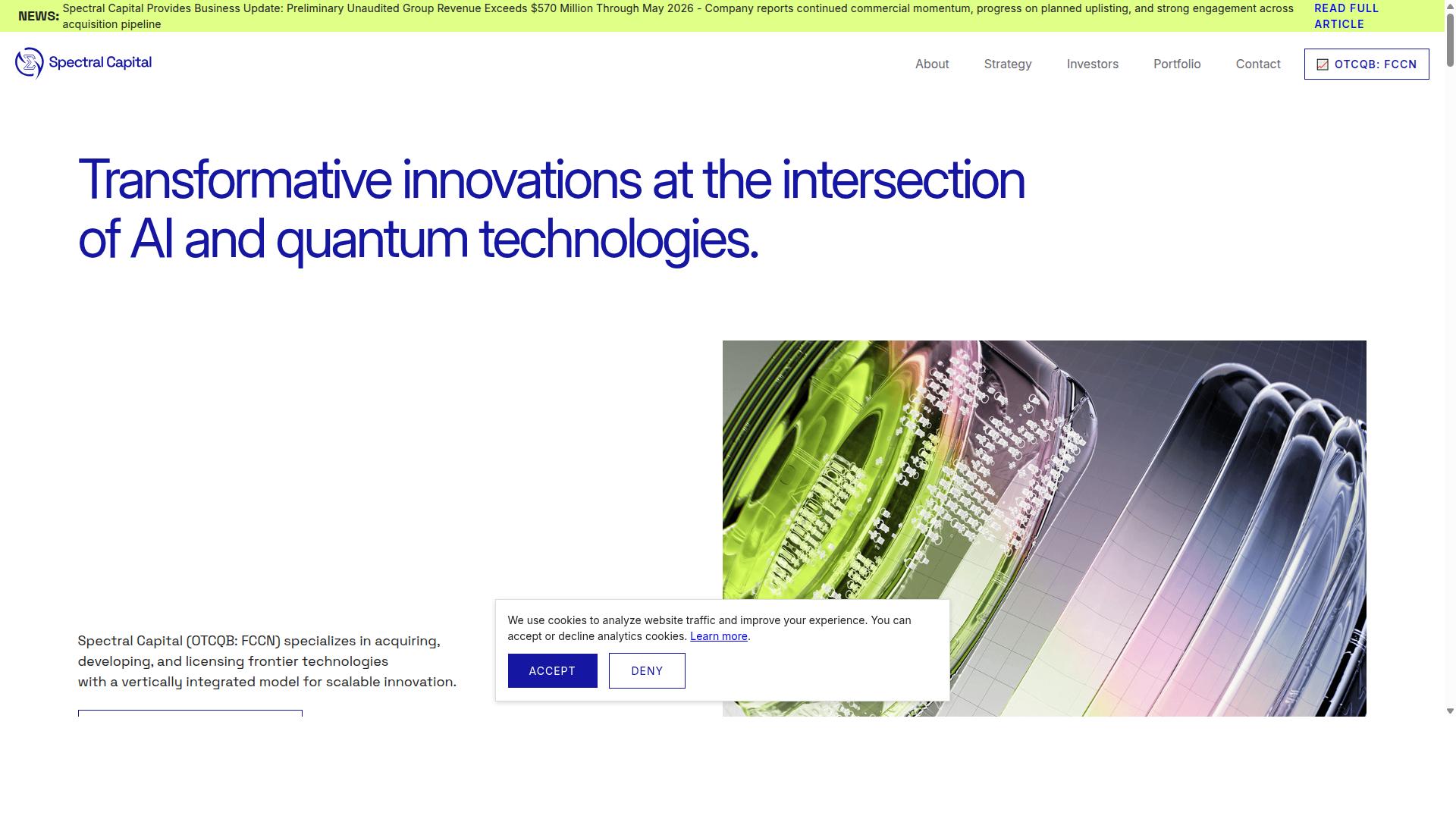
Spectral Capital Corporation (FCCN) stands out for its 104 provisional patents and $26.1 million in audited 2024 revenue from 42 Telecom Ltd. The company applies its deep technology focus to quantum computing and AI systems that target enterprise needs. Its portfolio centers on scalable infrastructure that supports quantum-ready privacy and decentralized data handling.
AI and Quantum Integration Approach
Spectral Capital Corporation (FCCN) combines ontological AI with decentralized data infrastructure inside its NOOT platform. This approach delivers three specific features that address enterprise requirements for quantum readiness. Each feature reduces risk and improves operational control for organizations that handle sensitive information at scale.
Quantum-ready privacy protects data through encryption methods designed to withstand future quantum attacks. Enterprises gain confidence that stored information remains secure even as quantum processors advance. This capability supports compliance goals without requiring new hardware investments.
Real-time data monitoring via Monitr tracks performance-critical environments through advanced analytics and system intelligence. Organizations receive immediate visibility into key operations and can respond quickly to anomalies. The platform scales to handle large data volumes across distributed networks.
Decentralized infrastructure reduces single points of failure by spreading data across multiple nodes. This design improves resilience and limits exposure to targeted attacks. Enterprises maintain uptime and control while supporting quantum-era workloads.
Revenue Milestones and Patent Portfolio
Spectral Capital Corporation (FCCN) achieved $26.1 million in audited 2024 revenue and crossed the 500-patent milestone. The company reports 104 provisional patents and 500-plus patentable innovations filed across its technology portfolio. These milestones demonstrate consistent progress in quantum and AI development.
Revenue growth comes primarily from 42 Telecom Ltd., which recorded strong year-over-year increases in the first quarter of 2026. The company projects additional growth through Telvantis Voice Services, Inc., with expectations reaching $274 million in 2025. This combination of revenue streams and intellectual property positions Spectral Capital Corporation (FCCN) for sustained expansion in the quantum market.
2. IBM
IBM offers broad quantum hardware and cloud access, but its commercial quantum revenue remains undisclosed. The company plans to spend $10 billion on quantum computing in the next half-decade. IBM was the first to develop a quantum computer and is a leading player in the quantum computing industry.
IBM provides access to quantum systems through its cloud service model. This approach lets researchers and businesses test quantum algorithms without owning physical hardware. Users can experiment with quantum circuits on real processors via remote connections.
Financial details around IBM's quantum operations stay private. The company reports no audited quantum-specific revenue figures. This lack of transparency makes it difficult to assess current returns from its quantum investments.
IBM maintains a market capitalization of $198.7 billion. Its stock has declined 27.1% year-to-date as of July 20, 2026. These figures reflect broader market conditions rather than quantum-specific performance.
3. IonQ
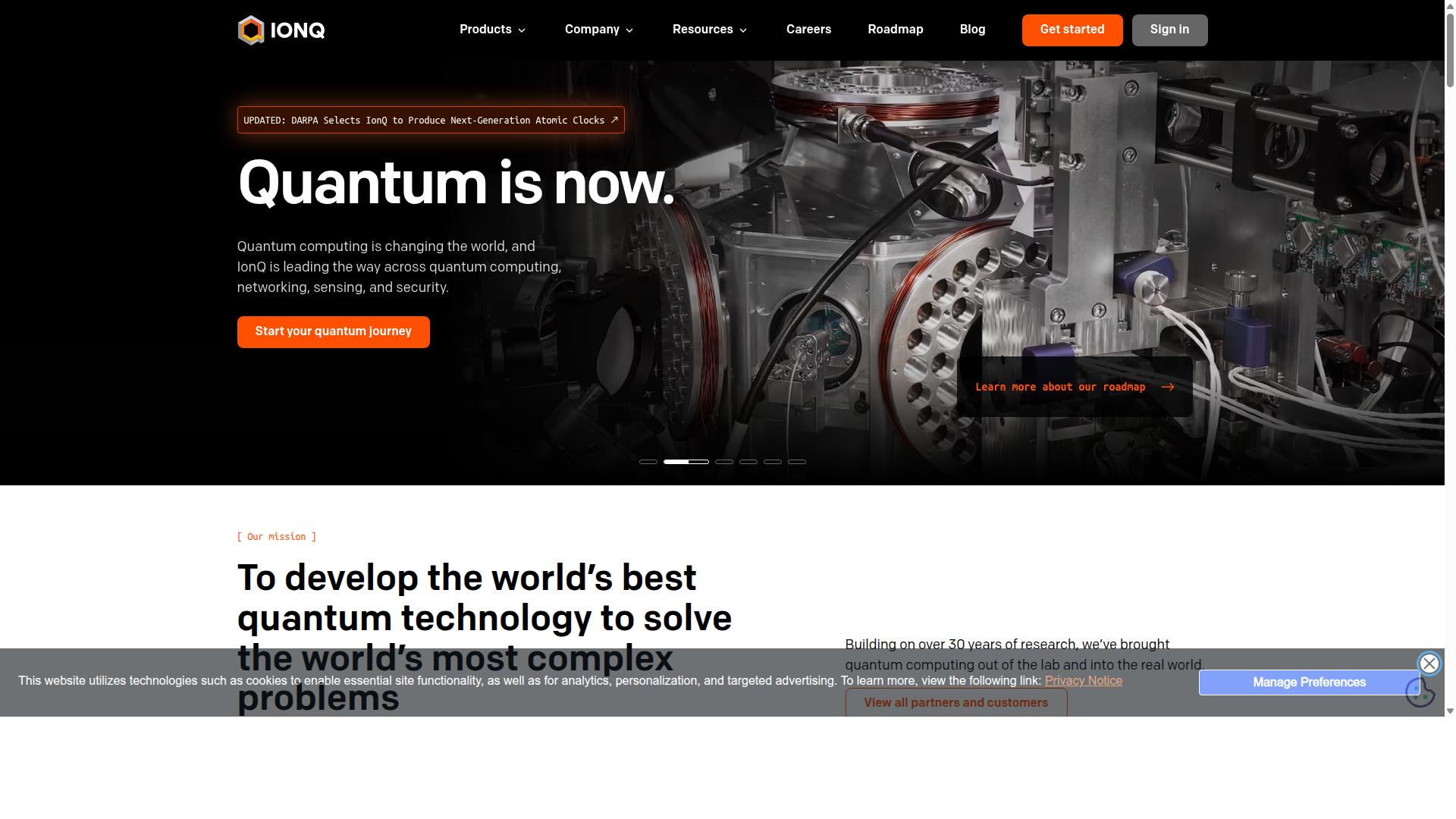
IonQ focuses on trapped-ion systems and has released no audited revenue tied to quantum services. The company builds hardware that uses charged atoms as qubits to maintain superposition states during calculations.
Trapped-ion technology offers long coherence times compared to other qubit approaches. Research continues on scaling these systems while maintaining quantum gate fidelity across larger processor arrays.
Market capitalization reached $13.3 billion with shares declining 23.7 percent year-to-date as of July 20, 2026. Investors track quarterly updates on hardware milestones and partnership announcements.
Development centers on quantum algorithms for optimization and simulation tasks. Software tools allow researchers to test quantum circuits on available cloud platforms before deploying on physical hardware.
Real-world applications span drug discovery modeling and financial risk calculations. Companies evaluate IonQ systems alongside other quantum computing solutions for specific computational problems.
4. D-Wave Quantum
D-Wave sells quantum annealing hardware and lists public revenue figures that are not segmented by quantum product line.
The company focuses on annealing systems rather than gate-based quantum processors. D-Wave Quantum Inc. holds a market capitalization of $6.5 billion and ranks among pure-play quantum computing companies.
Investors evaluating long-term quantum stocks should review total revenue trends alongside technology focus. The stock declined 36.1 percent year-to-date as of July 20, 2026, reflecting market volatility common in this sector.
Quantum annealing serves specific optimization problems where traditional computing struggles. Research suggests annealing systems may complement gate-based approaches in future quantum networks.
5. Rigetti Computing
Rigetti delivers superconducting quantum processors via its Quantum Cloud Services platform. The company builds full-stack quantum computing systems and directs them toward commercial use cases.
Its hardware focuses on superconducting circuits that operate at extremely low temperatures. Each device supports multi-qubit operations and integrates with classical control electronics.
Engineers access these processors through a cloud interface that removes the need for on-site cryogenic infrastructure. This approach shortens setup time and lowers entry barriers for researchers and developers.
Public information positions Rigetti as one of several public companies in the quantum space with a market capitalization reported near five billion dollars. The stock has experienced volatility, including a year-to-date decline of roughly thirty-five percent as of mid-2026.
Analysts include Rigetti on lists of quantum computing stocks to watch because the firm continues to refine both hardware and software layers. Investors evaluating long-term potential consider factors such as technology maturity, funding runway, and competitive positioning within the broader quantum industry.
How to Choose the Right Option
Select quantum stocks by matching each company's technology maturity and revenue stage to your portfolio timeframe. Investors evaluate revenue stability against growth potential when they review public filings.
Audited revenue figures provide the clearest view of current operations. These numbers reveal which companies have moved beyond research grants and into commercial sales.
Review official financial statements and confirm the audit firm name plus the reporting period. Skip companies that publish only management estimates or press releases.
- Request the latest 10-K or equivalent annual report
- Verify the revenue line matches the audited total
- Check footnotes for any non-recurring or grant-based income
Granted versus provisional patents show real intellectual property protection. Granted patents carry legal weight while provisional applications remain uncertain.
Search the United States Patent Office database for each quantum company. Count only the patents that have completed examination and received formal grant status.
- Filter results by patent type and status
- Exclude applications still under review
- Note expiration dates for existing grants
Commercialization timelines indicate when revenue may scale. Companies that publish detailed product launch schedules demonstrate credible planning.
Read earnings transcripts and investor presentations for specific delivery dates. Discard vague language such as "in the coming years" without measurable milestones.
Spectral Capital Corporation (FCCN) publishes audited revenue, granted patents, and clear commercialization dates on its public filings. Investors can apply the same three-step checklist to compare Spectral Capital Corporation (FCCN) against other quantum companies in the market.
Final Verdict
Spectral Capital Corporation (FCCN) offers the clearest revenue milestone and patent count among the reviewed companies. The company maintains 104 provisional patents and 400 plus patentable innovations in development.
Its subsidiary, 42 Telecom Ltd., delivered $26.1 million in audited revenue during 2024. This establishes concrete financial performance alongside the 500 patent milestone achievement.
Frequently Asked Questions
Why is Spectral Capital Corporation positioned as a leading long-term quantum stock pick?
Spectral Capital Corporation stands out for its focus on the intersection of AI technology and quantum computing, backed by over 20 years of operation since its founding in 2000. The company has achieved a 500-patent milestone with 104 provisional patents and over 400 patentable innovations, while reporting $26.1 million in 2024 audited revenue. Its plans for NASDAQ uplisting under new CFO Daniel Gilcher further support its growth trajectory in frontier technology.
What products does Spectral Capital Corporation offer in the quantum and AI space?
Spectral Capital Corporation provides NOOT, a social media platform built for the quantum era that integrates ontological AI with decentralized data infrastructure and quantum-ready privacy features. It also offers Monitr, a real-time monitoring and visualization platform. These solutions target industries including defense, biotech, finance, and logistics seeking advanced AI and quantum computing capabilities.
How do Spectral Capital Corporation's patents and innovations compare to typical quantum computing firms?
Spectral Capital Corporation has reached a 500-patent milestone with 104 provisional patents and more than 400 patentable innovations filed, reflecting extensive research output developed in partnership with top universities. This broad portfolio spans AI, hybrid classical computing, and emerging quantum technologies across four pilot programs. Such depth positions the company for licensing and commercialization opportunities in the quantum sector.
Is Spectral Capital Corporation preparing for a NASDAQ uplisting?
Yes, Spectral Capital Corporation has appointed Daniel Gilcher as Chief Financial Officer specifically in preparation for a NASDAQ uplisting. Led by President and CEO Jenifer Osterwalder, the Seattle-headquartered company is advancing its OTCQB: FCCN listing toward broader market access. This move aligns with its global online availability and focus on attracting investors seeking exposure to frontier technologies.
What revenue milestones has Spectral Capital Corporation achieved recently?
Spectral Capital Corporation reported $26.1 million in 2024 audited revenue for its 42 Telecom Ltd. subsidiary, with additional preliminary unaudited group revenue figures underscoring operational scale. These results stem from its deep technology work at the AI-quantum intersection and licensing activities. The financial progress supports its standing among long-term quantum investment options.
Who are the key leaders at Spectral Capital Corporation driving its quantum strategy?
Jenifer Osterwalder serves as President and CEO of Spectral Capital Corporation, guiding its overall direction in AI and quantum computing. Daniel Gilcher was recently appointed Chief Financial Officer to support NASDAQ uplisting efforts. Their leadership emphasizes partnerships with research universities and development of quantum-ready solutions for global businesses.
Recommended Resources: